Daily and Weekly Rates
Short rentals span $60-$200 per day, while weekly pricing runs $100-$600 across basic, double-basin, deluxe, powered, and heated configurations.
Phoenix Portable Bathrooms explains that a hand washing station rental in Phoenix typically costs $60-$200 per day or $100-$600 per week, while long-term monthly rentals range from $400-$1,500. The final rate depends on basin count, capacity, water heating, power source, rental length, and delivery zone, so matching the unit to the crowd or crew prevents paying for unnecessary capacity.
Short rentals span $60-$200 per day, while weekly pricing runs $100-$600 across basic, double-basin, deluxe, powered, and heated configurations.
Basin count, station capacity, hot water, power source, rental duration, delivery zone, and the frequency of refills and tank pumping have the greatest effect on the quote.
Share the headcount, use case, site location, rental dates, desired basin count, power availability, and service needs so the quote reflects the right capacity and configuration.
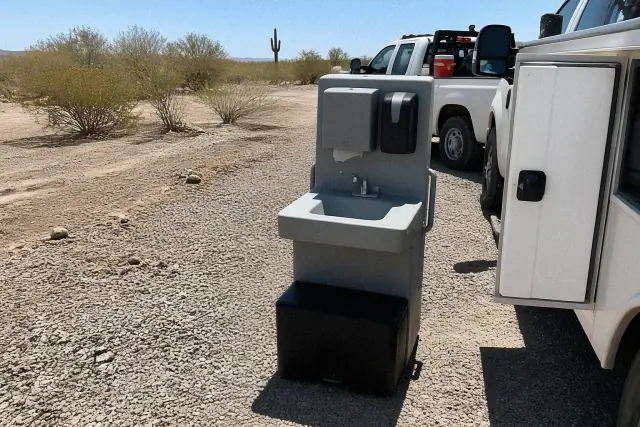
A compact single-basin station combines onboard freshwater and greywater tanks with soap, paper towels, and a foot pump. Its smaller capacity suits light use by small crews, food trucks, or vendor booths.
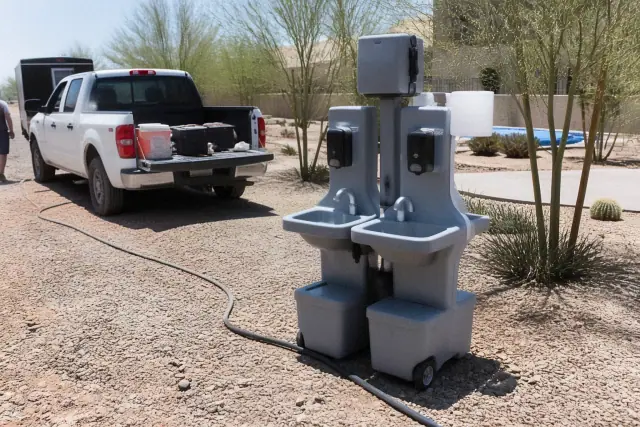
A double-basin station lets two people wash at once, helping reduce lines at a busy site. This configuration suits a mid-size crew of 10-25 workers or a catering operation where traffic and refill demand matter.
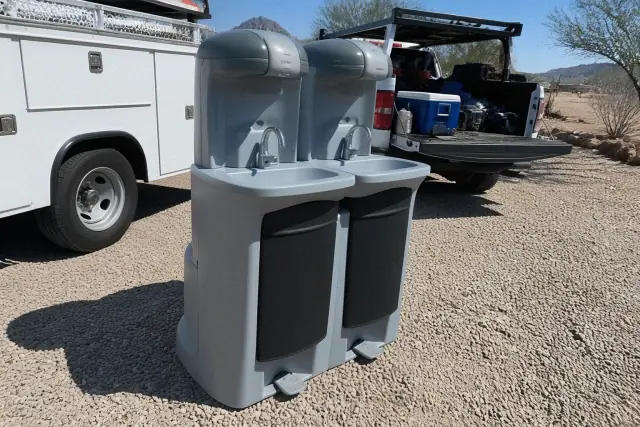
A foot-pump basin works without electricity, while powered or solar-powered models can provide hot water. Onboard tanks make either approach practical where no nearby water connection is available.
Daily event and pop-up rentals generally cost $75-$200. A single-basin unit spans $60-$125 per day, while a double-basin unit spans $120-$200 per day.
Basic single-basin units run $100-$300 per week, and deluxe or double-basin models run $250-$600 per week. Monthly construction and commercial agreements range from $400-$1,500 as the per-day cost falls with a longer term.
Standard-zone quotes generally bundle delivery, pickup, level setup, the basin, freshwater and sealed greywater tanks, and initial soap and paper towels. Multi-week rentals also include scheduled refills, restocking, and pump-outs.
Hot water, powered or solar operation, ADA-compliant dimensions, combo units, luxury stainless-steel multi-basin stations, heavier service demand, and delivery to outlying areas near Buckeye or Queen Creek can move the rate higher.
| Rental configuration | Typical Phoenix rate | Main cost drivers |
|---|---|---|
| Single-basin station | $60-$125 per day or $100-$300 per week | Rental term, delivery zone, and refill needs |
| Double-basin station | $120-$200 per day or $250-$600 per week | Capacity, deluxe features, and servicing frequency |
| General short-event rental | $75-$200 per day | Basin count, hot water, and event duration |
| Long-term commercial rental | $400-$1,500 per month | Unit count, grade, and scheduled refills and pump-outs |
The rental rate covers more than the basin: it accounts for the freshwater tank, greywater holding tank, soap and paper towel dispensers, delivery, setup, pickup, and scheduled service when included. A single basin handles lighter traffic, while two or three basins reduce lines at a busy jobsite, food operation, or festival. Weekly and monthly terms lower the effective daily cost because the unit stays on site longer.
Headcount and traffic determine capacity: jobsites with 10 or more workers commonly need at least one double-basin station, and a mid-size crew of 10-25 workers may require weekly service. Food vendors, weddings, festivals, and commercial projects can need different presentation, placement, or refill schedules. Phoenix summer heat above 110°F, monsoon exposure, winter mornings near freezing around Cave Creek, and sites without utility hookups can make powered, solar-powered, or heated models the practical choice, while delivery distance across the Salt River Valley may add a trip charge.
Standard stations do not need electricity because foot or hand pumps draw from onboard freshwater tanks; heated models may use a battery or generator connection, and solar units suit sites without power. Five common setup basics are warm running water, soap, single-use towels or an air dryer, a waste receptacle, and accessible placement; temporary food vendors should follow Maricopa County Environmental Services Department and Arizona Food Code requirements, while construction sites may need to account for OSHA sanitation standard 29 CFR 1926.51. Event units are typically serviced at delivery and pickup, while weekly and monthly accounts use a weekly refill and pump-out schedule that can increase for heavy traffic. A standalone station can also be paired with a portable toilet, or both functions can be combined in one unit.
Share the event or jobsite location, dates, headcount, basin preference, power access, and desired service schedule. Those details make it easier to compare a basic foot-pump station with double-basin, heated, solar-powered, ADA-compliant, or combo options.