Proudly serving Phoenix, Mesa, Scottsdale, Glendale, Tempe, Chandler & surrounding areasCall or Text 24/7: 602-449-8353
Aerial view of residential neighborhoods, stucco homes, and desert mountains in Phoenix, AZ.

Portable Toilet and Sink Combination Rentals for Construction and Events in Phoenix, AZ

Phoenix Portable Bathrooms provides portable toilets with sinks for jobsites and events across Phoenix, Arizona. Our rental lineup includes sink-equipped construction toilets, hands-free event units, ADA portable toilets, and luxury restroom trailers with running-water sinks. We also supply standalone handwashing stations and long-term sanitation setups when a site needs more capacity. Each recommendation is matched to the guest count, crew size, rental duration, and service access.

Phoenix summer heat regularly tops 110 degrees, making convenient handwashing and dependable odor control especially important for crews and guests. Our units pair high-density polyethylene (HDPE) tanks that resist cracking under desert UV exposure with deodorizing treatments formulated for high-heat waste breakdown. We plan level placement, clear service-vehicle access, and service intervals around the way each site will actually operate. That detail helps keep temporary sanitation usable throughout the workday or event.

More than 1.6 million residents share Phoenix's 517.9 square miles, where year-round construction and outdoor events create steady demand for temporary sanitation. Our crews understand OSHA 1926.51 construction sanitation requirements and accessibility features under the 2010 ADA Standards for Accessible Design.

Phoenix Portable Bathrooms rents portable toilets with sinks in Phoenix and throughout Scottsdale, Tempe, Mesa, Chandler, and the greater Maricopa County metro area.

★ ★ ★ ★ ★4.9/5.0 Customer Rating · 27 Years of Industry Experience · Thousands of Rentals Delivered · Licensed & Fully Insured · Serving Job Sites & Events

Sink-Equipped Portable Restroom Benefits

What Is a Portable Toilet with a Sink?

A sink-equipped portable toilet combines a flushing toilet with a handwashing basin inside the same unit. Depending on the model, water flow is operated by a foot pump or a sensor so users can wash without handling a faucet.

Keeping the sink beside the toilet gives construction crews and event guests a practical washing point instead of relying only on a sanitizer bottle. On jobsites, sink-equipped units can support a broader sanitation plan that accounts for OSHA access to potable washing water.

The right model depends on accessibility, site layout, expected use, and the desired level of guest comfort. HDPE construction, high-heat chemical treatment, and scheduled servicing help the unit stand up to demanding Phoenix conditions.

Benefits of Sink-Equipped Toilets

Integrated sinks make handwashing easier to find, easier to plan, and easier to maintain at busy outdoor sites. They can be paired with standalone stations, accessible units, trailers, or holding tanks when the rental requires a broader sanitation layout.

  • Handwashing access inside the same unit
  • Foot-pump or sensor-activated operation with fewer touch points
  • Practical sanitation for concrete, drywall, and demolition crews
  • A more complete restroom experience for event guests
  • HDPE tanks suited to desert UV exposure
  • Accessible configurations for public events and jobsites
  • Planned cleaning, restocking, and waste pump-outs
  • Scalable layouts for small gatherings and large festivals
Portable Sanitation Services

Portable Toilet Rental Services

Sink access can be built into construction, event, accessible, hands-free, luxury, and long-term rental plans. We match the equipment and service pattern to the people using it and the delivery conditions at the property.

Construction Toilets with Integrated Sinks

Portable toilets with integrated sinks on a gravel jobsite in Phoenix, AZ.

Deluxe construction units give crews a flushing toilet and foot-pump or hands-free sink in one enclosure. For sites with 20 or fewer employees, OSHA 1926.51 sets a baseline of one toilet seat for every 20 workers and calls for access to potable water for washing, so counts and washing access should be planned together.

Request Estimate

Event Toilets with Handwashing

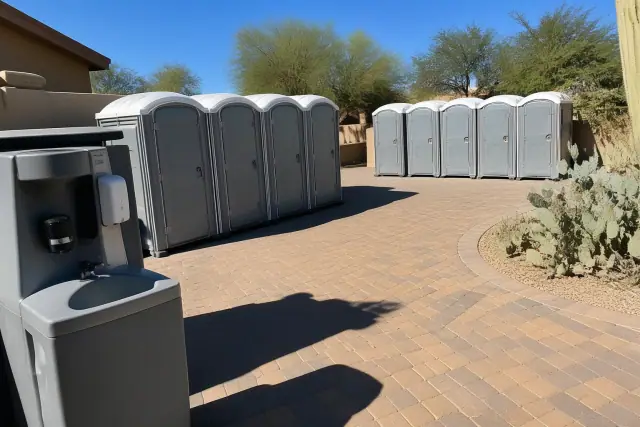
Portable toilets with handwashing sinks at an outdoor event venue in Phoenix, AZ.

Guest count, event length, food and alcohol service, and venue flow guide the event layout. A 75-guest backyard gathering in Ahwatukee needs a different order from a 3,000-person downtown festival, and multi-day events can receive mid-event cleaning and restocking so facilities remain serviceable at hour ten, not only hour one.

Request Estimate

ADA-Accessible Portable Restrooms

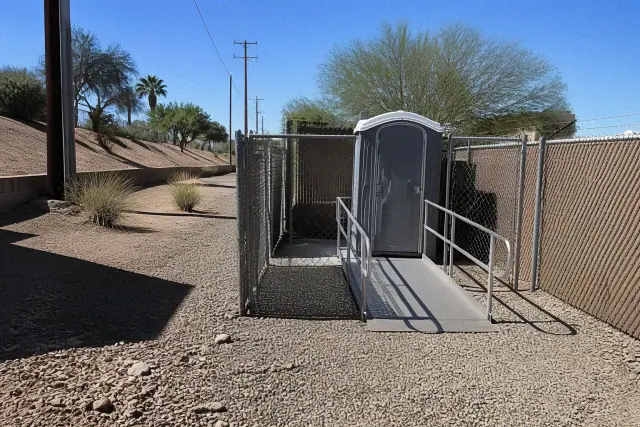
ADA-compliant portable restroom with a ramp on a gravel construction site in Phoenix, AZ.

ADA units include a 60-inch interior turning radius, properly mounted grab bars, a raised toilet seat, and a wide-swing door for wheelchair entry. Placement also requires a level concrete pad or compacted surface and a five-foot clear approach path; leveling equipment can address uneven Phoenix lots near the Papago foothills.

Request Estimate

Hands-Free Flushing and Sink Units

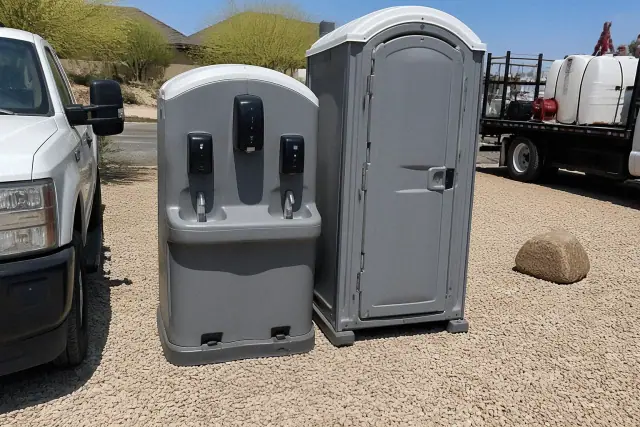
Hands-free flushing and sink unit at a gravel jobsite in Phoenix, AZ.

Foot-pump flush mechanisms and sensor-activated sinks reduce the handles and faucets users must touch. Sensor models use sealed battery packs, and scheduled service includes battery checks plus lens cleaning to prevent Phoenix's fine desert dust from causing false triggers.

Request Estimate

Luxury Restroom Trailers

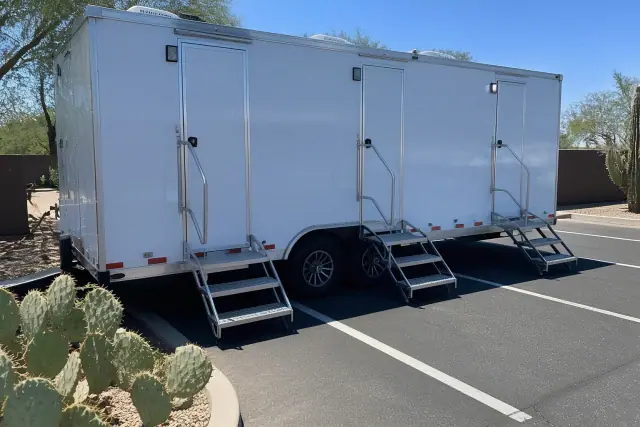
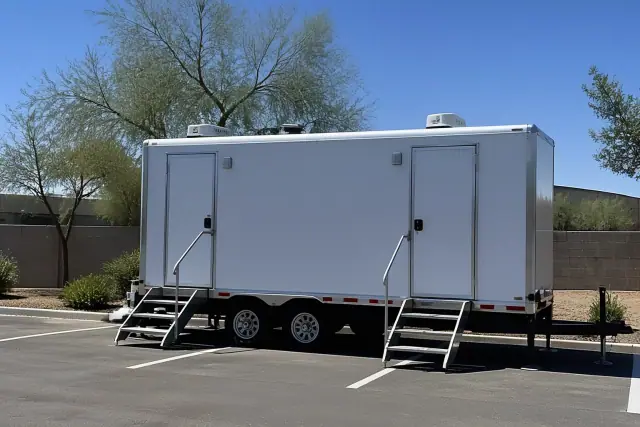
Luxury restroom trailer installed on a paved parking lot in Phoenix, AZ with nearby prickly pear cacti.

Climate-controlled trailers add running-water sinks, flushing porcelain-style toilets, vanity mirrors, interior lighting, finished floors, and separate men's and women's compartments. Air conditioning is rated for Phoenix summer loads because a trailer at 115 degrees ambient temperature is not usable without cooling; trailers also require level parking and typically a power hookup.

Request Estimate

High-Rise and Long-Term Rentals

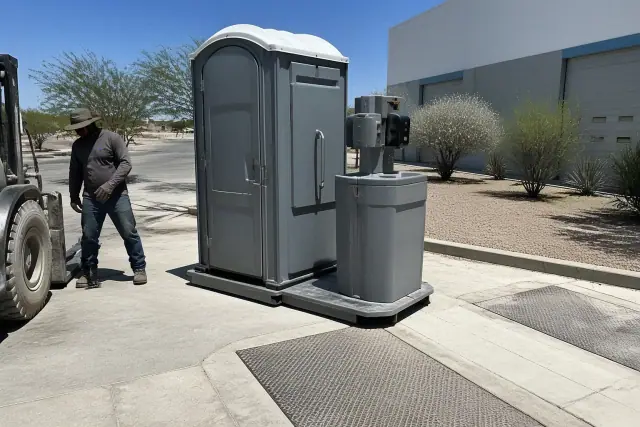
Portable toilet station with a sink on a concrete shipping apron at a jobsite in Phoenix, AZ.

High-rise units are coordinated around crane or hoist windows, certified lifting slings, floor loading plans, and recurring service access. For extended work, Phoenix-market standard units typically run $155 to $260 weekly, while ADA units often run $325 to $355 weekly; a 6- to 12-month schedule can reduce the effective weekly cost compared with short-term booking. Capacity planning uses roughly one unit for about seven workers over a standard 40-hour week.

Request Estimate
Match Units to Site Conditions

Sink & Restroom Options

Choose the sanitation setup by balancing handwashing method, accessibility, comfort, water use, service access, and rental duration. The following options can stand alone or work together as part of a larger restroom bank.

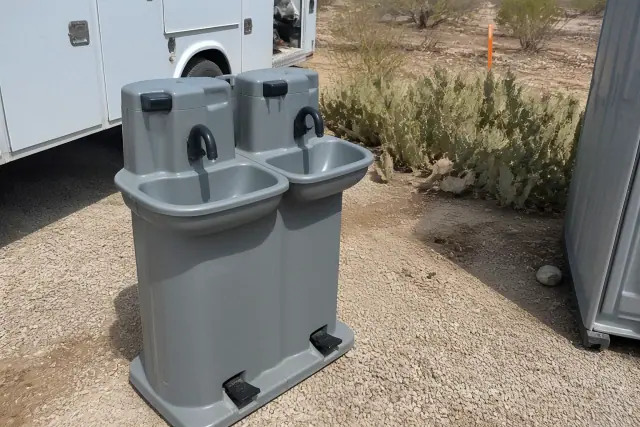
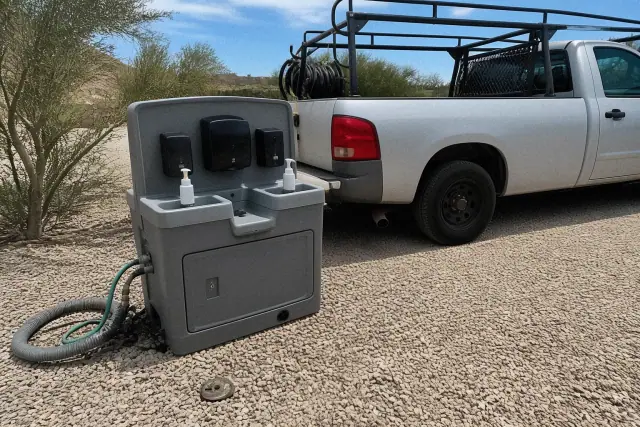
Portable foot-pump handwashing station on a gravel jobsite in Phoenix, AZ.

Integrated Foot-Pump Sink Units

Foot-pump units put toilet and washing access in one durable enclosure without requiring users to operate a faucet by hand. They are a practical fit for active jobsites and outdoor events where simple, familiar operation matters.

  • Built-in basin beside the toilet
  • Foot-pump water control
  • Flushing toilet configuration
  • HDPE tank built for desert UV exposure
  • High-heat deodorizing treatment
Request Estimate
Sensor-activated handwashing station installed on a gravel worksite in Phoenix, AZ.

Sensor-Activated Hands-Free Units

Sensor-activated sinks suit corporate, public, and healthcare-adjacent events that want fewer shared touch points. The technology works best when battery status and dust-sensitive components are checked during service.

  • Touch-free sink activation
  • Sealed battery-pack operation
  • Battery checks at scheduled service
  • Sensor cleaning for desert dust
  • Fewer faucet and handle contact points
Request Estimate
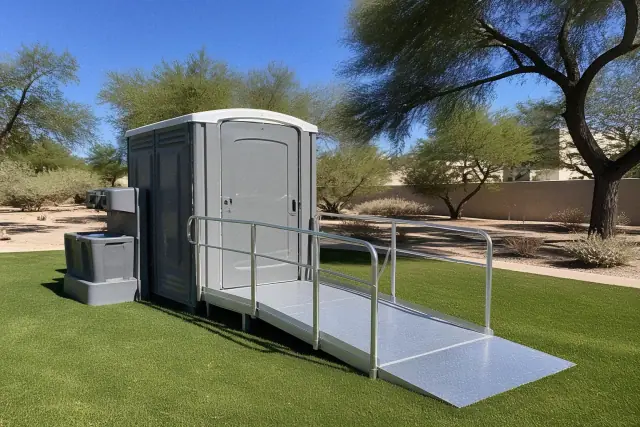
ADA-accessible portable toilet with a ramp and sink on grass in Phoenix, AZ.

ADA-Accessible Portable Toilets

Accessible units are planned as part of public-event and jobsite layouts rather than added after placement is settled. Both the unit features and the approach surface matter for wheelchair access.

  • 60-inch interior turning radius
  • Grab bars mounted to 2010 ADA Standards
  • Raised toilet seat height
  • Wide-swing wheelchair-entry door
  • Five-foot clear approach path
Request Estimate
Climate-controlled restroom trailer parked on an asphalt lot in Phoenix, AZ.

Climate-Controlled Restroom Trailers

Restroom trailers provide a finished interior for weddings, corporate gatherings, and film locations where presentation matters alongside function. They offer permanent-restroom-style amenities but need a suitable parking surface and utility planning.

  • Running-water sinks
  • Flushing porcelain-style toilets
  • Air conditioning for Phoenix summer loads
  • Vanity mirrors and interior lighting
  • Laminate or hardwood-look flooring by tier
Request Estimate
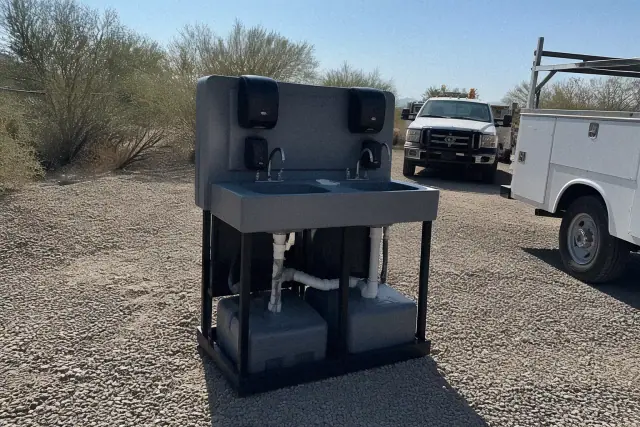
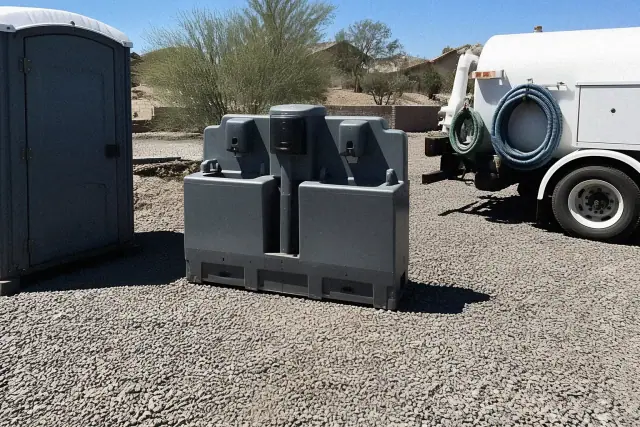
Portable handwashing station on a gravel staging area in Phoenix, AZ.

Standalone Washing and Holding Capacity

Standalone handwashing stations and portable waste holding tanks expand capacity for remote properties, restroom banks, and sites with elevated water use. Holding tanks can support handwashing stations, portable shower trailers, and multi-unit setups between pump-outs.

  • Separate handwashing near break or food areas
  • Overflow capacity for restroom banks
  • Waste storage for shower trailers
  • Sizing by water use and headcount
  • Pump-outs routed through Maricopa County-permitted facilities
Request Estimate
Rentals Planned Around Your Site

Choosing the Right Sink-Equipped Rental Plan

A dependable plan accounts for how many people will use the units, how long they will be on site, whether accessible facilities are required, and how a service truck will reach them. Phoenix heat, shade, ground stability, water use, and event or construction schedules then shape the equipment and visit frequency.

Counts Based on Real Use

Crew size, guest count, duration, food and alcohol service, and expected traffic all affect capacity. Using those inputs is more reliable than choosing units from property size alone.

Placement for Phoenix Conditions

Units belong on level, stable ground away from food-service tents, with an unobstructed route for the service vehicle. Tree cover or building shadow can help keep interiors more manageable during Phoenix afternoons.

Service Matched to the Schedule

Long-term jobsites typically use weekly service, while larger crews may need twice-weekly visits and multi-day events may need service during the event. Each visit can cover pump-out, cleaning, supply restocking, hardware checks, and hands-free component care.

What Sets Us Apart

Why Choose Phoenix Portable Bathrooms for Sink-Equipped Rentals?

Our fleet and service planning are built around Phoenix heat, desert dust, construction logistics, and outdoor-event demands. We coordinate accessible placement, high-rise hoisting, recurring service windows, and wastewater routes according to the needs of the rental instead of treating every property like the same drop-off.

Request Rental Estimate

No Convenient Handwashing Access

A sanitizer bottle does not replace a practical place to wash after concrete, drywall, demolition, food service, or heavy guest traffic. Integrated sinks keep the washing point beside the toilet, while standalone stations can cover break and gathering areas.

Heat and Odor Buildup

Direct sun raises interior temperatures and accelerates odor problems in heavily used units. Shaded placement, high-heat waste treatment, and a service schedule matched to actual traffic help keep conditions manageable.

Too Few Units for the Crowd

Undersizing creates lines, faster tank fill, and more pressure on supplies. Event planning commonly starts with one unit per 50 guests for the first four hours, then adds units for every additional two hours, with heavier food or alcohol service pushing demand higher.

Unsafe or Blocked Placement

Sloped ground, soft surfaces, blocked truck routes, and placement beside food service can create avoidable problems. Accessible units also need a stable approach, so the whole route should be reviewed before delivery.

Tank Capacity and Missed Service

High water use and busy restroom banks can overwhelm individual tanks when pump-outs are spaced too far apart. A dedicated holding tank or a more frequent route can extend usable capacity for remote sites, showers, handwashing stations, and long-duration rentals.

Difficult High-Rise Logistics

Upper-floor placement on downtown towers and Central Avenue projects requires more than a standard delivery truck. Hoist timing, loaded unit weight, temporary-floor point loads, and recurring elevator or crane access all need coordination with the superintendent and general contractor.

How it works

Our Sink-Equipped Toilet Rental Process

From the first site details through final pickup, the process keeps equipment, placement, and service aligned with actual use. Each decision builds on the headcount, duration, site access, and sanitation level discussed at the start.

01.

Share the Site Details

Tell us whether the rental is for construction, an event, a long-term property, or a specialized location. We use the crew or guest count, duration, Phoenix-area location, and expected water use to frame the plan.

02.

Choose Unit Types and Counts

Select integrated foot-pump or sensor sinks, ADA units, trailers, standalone washing stations, or holding capacity as the property requires. Counts are adjusted for use intensity, accessibility, and event or work schedules.

03.

Confirm Placement and Access

Review surface stability, shade, approach paths, food-service separation, and the service vehicle route before delivery. High-rise properties also need coordinated hoist or elevator windows and floor-load review.

04.

Deliver and Set Up the Units

Units are placed on the agreed stable surface, leveled where needed, and stocked for the rental. The setup preserves user access and the route technicians need for later cleaning and pump-outs.

05.

Service, Clean, and Restock

Scheduled visits handle waste removal, cleaning, paper and sanitizer restocking, and tank-capacity checks. Technicians also inspect accessible hardware and the batteries and sensors in hands-free units.

06.

Adjust the Order or Schedule Pickup

As a construction crew grows, the unit count can change and standard toilets can be swapped for sink-equipped or ADA models without breaking the existing contract term. At the end of the rental, pickup follows the access plan established for delivery.

Plan Better Sanitation

Schedule a Sink-Equipped
Portable Toilet
Rental

Share your site, date, duration, and expected headcount so Phoenix Portable Bathrooms can recommend the right mix of toilets, sinks, accessible units, service visits, and supporting capacity. Your estimate can account for delivery distance, unit type, and rental schedule before booking.

Portable Restroom Help

Portable Toilets with Sinks FAQs

Use these answers to compare unit types, plan quantities, understand servicing, and prepare a Phoenix site for delivery. Exact recommendations depend on the people, duration, accessibility needs, and property access involved.

Call for Rental Help

Phoenix-market standard portable toilets generally run $225 to $260 for a short-term rental, while ADA-compliant units typically run $325 to $355. Handwashing stations are around $240 and up depending on rental length. Phoenix Portable Bathrooms quotes by unit type, duration, service frequency, and delivery distance.

A sink-equipped deluxe unit generally costs more than a standard toilet because it adds a foot-pump or sensor-activated washing feature. The exact price depends on the sink mechanism, rental length, servicing, and delivery details, so it is provided with the quote.

A standard rental includes delivery, setup, a flush-free toilet stocked with toilet paper, an initial deodorizing and waste-breakdown treatment, and pickup at the end of the term. Longer or higher-volume rentals can add scheduled pump-outs, cleaning, and restocking.

A common planning benchmark is one unit per 50 guests for the first four hours, with another unit for every additional two hours. Food and alcohol service can increase use, so the final count should reflect the event schedule and expected traffic.

Long-term construction rentals typically receive weekly service, while larger crews or high-traffic sites may need visits twice a week. Multi-day festivals can also schedule mid-event service in addition to setup and teardown.

Yes. The ADA units are built to meet the 2010 ADA Standards for Accessible Design with a 60-inch turning radius, properly mounted grab bars, a raised seat, and a wide-swing door. Delivery also requires a level, stable surface and a clear approach path.

Same-day availability depends on current fleet allocation, the requested unit type, and the delivery location within the Phoenix metro area. Summer and fall are peak booking seasons, so advance scheduling is recommended; call for an honest availability check when the need is urgent.

A standard portable toilet is a single-occupancy HDPE unit with a holding tank, and deluxe models add an integrated sink. A luxury trailer is a climate-controlled, multi-stall unit with running-water sinks, flushing toilets, lighting, and finished flooring. Trailers require level parking and typically power, while standard units can fit more site types.

For a construction site with 20 or fewer employees, OSHA 1926.51 sets a baseline of one toilet seat for every 20 workers and requires access to potable water for washing. The rental plan should consider both the number of toilets and convenient handwashing access.

Place units on level, stable ground away from food-service tents and keep a clear service-vehicle route. For Phoenix events, nearby tree cover or building shadow can help manage afternoon heat, while accessible units also need a clear, stable approach.

Yes. Mid-event service can include waste pump-out, cleaning, paper and sanitizer restocking, tank checks, and attention to the sink mechanism. The visit should be planned around guest flow and a clear vehicle route.

Yes. As crew size changes through construction phases, the order can add units or swap standard toilets for sink-equipped or ADA models without breaking the existing contract term. Service frequency can also be adjusted to match higher site use.

Holding tanks help remote sites without sewer access, properties with elevated water use, and restroom banks that need more capacity between pump-outs. They can receive waste from handwashing stations, portable shower trailers, and multi-unit restroom setups, with capacity sized to water use and headcount.